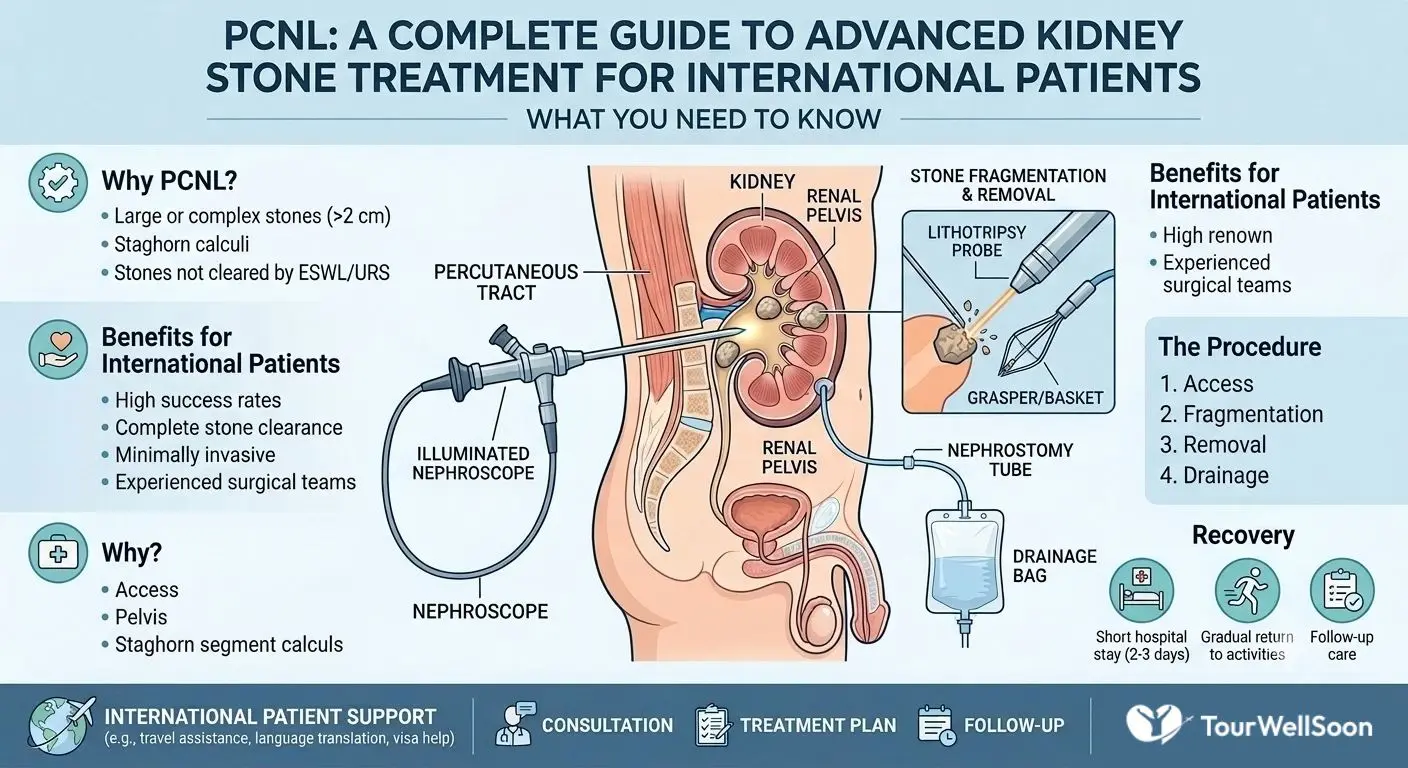
Percutaneous Nephrostolithotomy (PCNL): Advanced Kidney Stone Treatment
Kidney stones can cause severe pain, urinary obstruction, and recurrent infections. While smaller stones can often be treated with non-invasive methods like medication or shockwave lithotripsy, larger or more complex stones require advanced surgical intervention. Percutaneous Nephrostolithotomy (PCNL) is a modern keyhole surgical procedure designed to remove large kidney stones safely and efficiently.
For international patients traveling to India for urological care, top-tier JCI and NABH-accredited medical centers offer world-class PCNL procedures performed by internationally trained urologists. This guide breaks down everything you need to know about PCNL from pre-admission preparations to home recovery protocols and explains how TourWellSoon supports your journey every step of the way.
1. Admission & Pre-Operative Preparation
When you are admitted for a PCNL procedure, the medical team conducts thorough evaluations to ensure you are fully prepared for surgery:
- Preoperative Investigations: You will undergo routine tests to assess your fitness for surgery and anesthesia, including a hemogram, blood biochemistry, chest X-ray, and ECG. Additional tests such as Echocardiography or Pulmonary Function Tests (PFT) may be conducted depending on any co-existing health conditions.
- Pre-Anesthesia Check-up (PAC): An anesthesiologist will evaluate your health status and clear you for anesthesia.
- Ward Preparation: You must follow strict overnight fasting (nil by mouth, meaning no solid food or liquids, including water).
- Informed Consent: Your attending doctor will explain the risks and benefits of the procedure, after which you will sign an informed consent form.
2. What is PCNL and How is it Performed?
PCNL is a form of keyhole surgery carried out under general or spinal anesthesia. Because it is performed through a very small cut in the skin, it leaves only a minor scar.
The surgical procedure takes place in two key stages:
- Stage 1 (Bladder Examination): Once you are anesthetized, the urologist performs a cystoscopy to examine your bladder and passes a small tube up into the kidney.
- Stage 2 (Stone Removal): You are positioned face down (prone position) to give the surgeon optimal access to your kidney. Using real-time X-ray guidance, an access track is created through a tiny skin incision into the kidney. A specialized surgical telescope (nephroscope) is inserted to locate the stone, break it into smaller fragments, and remove the pieces.
- Tube Placement: Once the stone is removed, a catheter called a nephrostomy tube is inserted into the kidney and stitched to the skin to drain urine and blood into a collection bag for 1–2 days. A urinary catheter is also placed in the bladder.
3. What to Expect During Your Hospital Stay
Your hospital stay usually lasts 1 to 2 days. During this time, the medical team will monitor your recovery closely:
- Hydration & Drip: You will have an intravenous (IV) drip in your arm to receive fluids and prevent dehydration.
- Catheter Monitoring: Your urine will look red initially, but it will gradually become lighter in color as healing progresses.
- Diet & Fluids: You will typically resume a normal diet starting the day after surgery. It is essential to drink plenty of fluids to keep your urine clear.
- Discharge: Once your urine becomes clear, the catheter and nephrostomy tube are removed, and you will be cleared for discharge.
4. Post-Discharge & Home Recovery Guidelines
Proper home care is crucial to prevent complications and reduce the risk of stone recurrence:
- Fluid Intake: Drink 2 to 3 liters of fluid daily to maintain strong urine flow and prevent new stones from forming.
- Dietary Precautions: Follow the specific dietary advice given by your urologist based on the chemical composition of your stone.
- Activity Restrictions: Avoid strenuous activity, heavy lifting, and physical straining for 4 to 6 weeks post-surgery. This includes avoiding contact sports, mowing lawns, gardening, vacuuming, and carrying heavy laundry baskets.
- Managing Blood in Urine: Intermittent blood in your urine can occur after discharge. Rest and drink extra water to help clear the urine.
🚨 When to Seek Immediate Medical Attention: Contact your doctor or visit the emergency room immediately if you experience a large amount of blood in your urine, severe flank pain, or a high-grade fever.
How TourWellSoon Assists Your Treatment Journey
Undergoing kidney stone surgery abroad can feel overwhelming, but TourWellSoon handles every detail of your care in India:
- Hospital & Specialist Selection: We connect you with top urology centers and experienced surgeons specializing in minimally invasive PCNL and laser lithotripsy.
- Medical Visa & Invitation Letters: We facilitate your official Medical Invitation Letter to streamline your e-Medical Visa application.
- Dedicated Patient Care Executive: A care coordinator accompanies you for hospital admission, language interpretation, and discharge formalities.
- Post-Discharge Recovery Accommodation: We arrange comfortable, fully serviced hotel stays close to your hospital, complete with on-demand home nursing and follow-up consultation coordination.
Medical Disclaimer: The information presented in this article is strictly for general educational and informational purposes. It should not be used as a substitute for professional medical advice, diagnosis, or treatment. Decisions regarding surgical procedures like PCNL must be made in consultation with a qualified urologist after a thorough clinical evaluation.
Need Assistance Planning Your Medical Travel?
Let TourWellSoon simplify your healthcare journey in India with personalized assistance, top hospital bookings, visa guidance, and full on-ground care.
📧 Email: help@tourwellsoon.com
📞 Call / WhatsApp: +91-88105 22512
🌐 Website: tourwellsoon.com